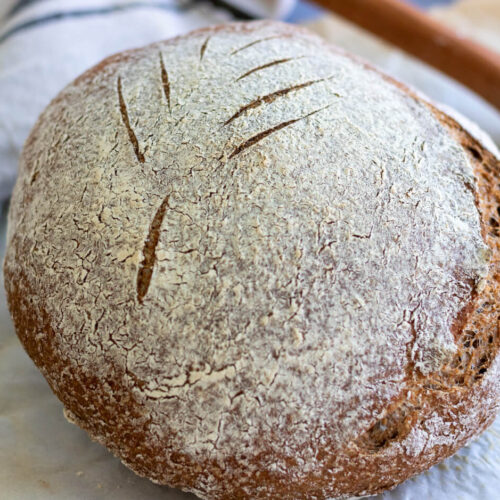
Sourdough Boule with Freshly Milled Flour
This sourdough boule made with freshly milled flour is so easy to make. It has just a few simple ingredients and a straightforward technique. It produces a wholesome loaf from just starter, freshly milled flour, water, and sea salt.
Equipment
- Dutch Oven, at least 5 quarts
- Grain Mill
- Banneton Basket
- Hard Wheat Berries
- Dough Whisk optional
Ingredients
- 345 grams water
- 485 grams hard red wheat berries ground into flour
- 100 grams active sourdough starter
- 10 grams sea salt
Instructions
- Feed your sourdough starter. To ensure your starter is at its peak, make sure you’ve fed it 8-12 hours before you bake your bread. I feed mine the night before I plan to make bread.
- Combine the water and starter.Place your bowl on your food scale and zero it out (press the tare button.) Pour in 345 grams of water. *If your kitchen is warm then room temperature water is fine. Otherwise warm it up. You don't want the water to be more than 90 degrees. Add 100 grams of starter and mix with your hands or a dough whisk until it is mixed into the water. The water will look milky.
- Place your bowl with the combination of water and starter underneath the grain mill. Measure out 485 grams of hard wheat and mill it directly into the bowl.
- Using your hands or a dough whisk, mix together the flour and water/starter until fully combined. You will have a shaggy dough. If you are used to using all-purpose or bread flour then the dough will feel very wet and you will be tempted to add more flour. Don't do it! The fresh milled flour takes longer to absorb the liquid but I promise it will come together. Cover the bowl with a damp tea towel, plate, or plastic shower cap and let it sit for an hour.
- After an hour, add 10 grams of sea salt, pinch it into the dough, and start your stretch and folds.
- Perform sets of stretch and folds every 30 minutes to an hour for a total of 4 - 6 times.To properly do a stretch and fold, imagine your loaf is a square. You will take one side, stretch it as high as it will go, and fold it over to the opposite side. You will rotate the bowl a quarter turn, and repeat this process until all four sides have been stretched and folded. The first few stretches won't stretch much but as the gluten develops it will gets stretchier.
- To shape your Boule, flour your work surface lightly, and gently lay the dough into a rectangle. Roll it up like a hot dog bun, then take the opposite side, and roll it up, creating a traditional round loaf. You will want to pull on it slightly against the counter to create tension. Try not to deflate all the air bubbles you’ve worked so hard to create.
- Place your loaf into a banneton basket, cover with plastic wrap, a plastic bag, or a shower cap, and put it into the fridge overnight.
- The next day place your dutch oven into your range and preheat your oven to 490°.When the oven is preheated take your banneton basket out ofthe fridge. Flip the dough from the basket onto a piece of parchment paper and rub the top of the dough with flour (use whatever you have on hand). Then, taking a razor blade or lame, score your bread. Carefully place your boule into the preheated dutch oven, cover it with the lid, and bake for 20 minutes. After that, remove the lid, reduce the temperature to 465°F , and bake for another 20–25 minutes until the loaf has a deep golden-brown crust.
- Let your bread cool for at least an hour before slicing into it. Really, you should let it cool completely before slicing, but who can resist warm bread?! If you slice into it before it's cooled at least slightly then you will find it slightly gummy. Happy baking!
Notes
- Read my detailed instructions in the blog post. I go into more depth.
- This is not going to perform or be as fluffy as store bought bread or a loaf using all purpose flour. It's amazing and delicious, but different.
- Make sure your starter is active. If it's not, the bread won't rise.
- If your house is cold then put this in a warm place to ferment. In the winter, I put it a few feet away from the fire.